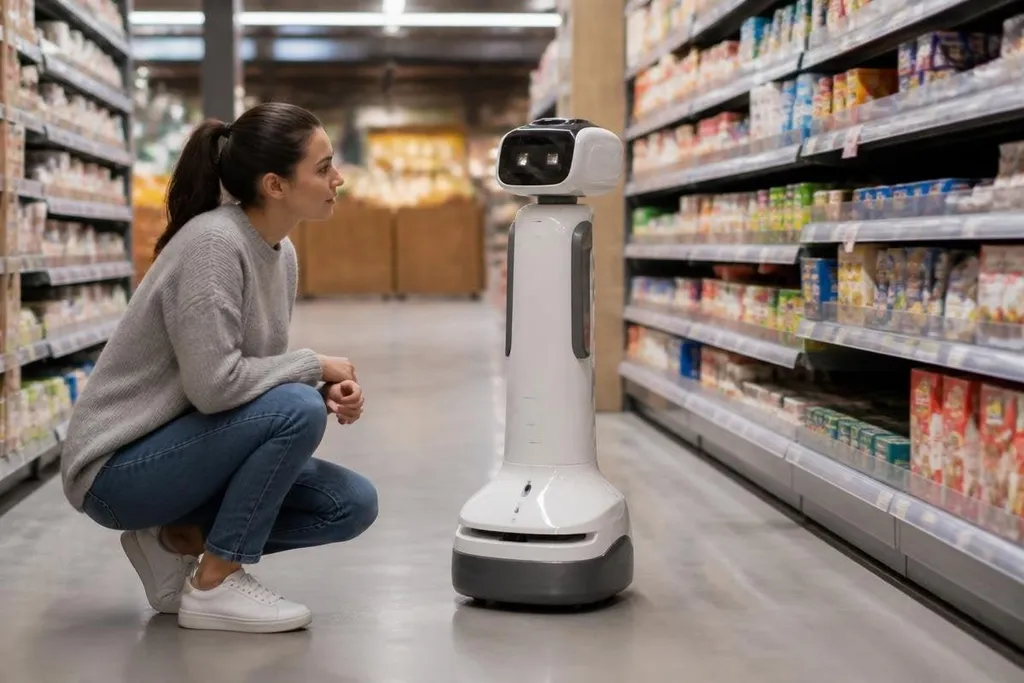
A customer who can't find an item often asks a worker, checks a phone, or leaves without buying it. A store robot could shorten that search by checking shelf locations, reading product labels, and giving clear directions.
The idea sounds simple, but useful service depends on more than putting wheels under a screen. The robot must know where products are, understand what the customer means, and avoid sending people to an empty shelf.
- Shelf checks: Cameras and barcode readers can record product locations.
- Customer help: A screen or voice system can answer requests and show a route.
- Stock limits: The robot needs fresh shelf data before it points someone down an aisle.
What the robot needs to know
A product-finding robot starts with a map of the shop. That map can include aisles, shelves, checkout areas, entrances, and places where customers cannot walk.
LiDAR, a sensor that measures distance with light, can help the robot locate itself as it moves. Product data matters just as much. A barcode identifies an item, while a camera can read signs and shelf labels.
Radio-frequency identification, or RFID, can identify tagged items without requiring a direct view, but the store must already use those tags for the robot to read them.
The robot also needs a way to match a customer’s words with a product record. “Size 10 black running shoes” asks for more than one word match. The system has to sort the type, size, color, and stock status before giving an answer.
That answer should include a shelf location and a useful warning when needed. If the store data is old, the robot should say that the item may have moved or sold out instead of sending the customer on a pointless walk.
How someone might use it
Someone could speak to the robot, type on its screen, or scan a shopping list. The robot could then show the aisle and shelf, lead the customer there, or display a map for them to follow.
The route needs to suit the store. A person using a wheelchair may need a wider path. A parent with a stroller may prefer fewer turns. A customer in a hurry may want the location on their phone rather than an escort across the shop.
The robot can also answer follow-up requests. Someone asking for printer paper may then ask for ink that fits the same printer. That second answer depends on product records supplied by the retailer, so the robot should state when a match has not been checked.
A store robot has to match a spoken request to the right shelf and product record. Reports on store robots from Robot24.com can trace that task from a demo to a real aisle, where missing data or staff help may change the result.
Where the plan can fail
A robot cannot fix bad store data. Products may sit in the wrong shelf space, a returned item may be in a service area, or the last unit may be in a customer’s basket.
A map can be accurate while the answer is still wrong. Crowded aisles create another problem. The robot must stop when a person steps into its path, then find a safe route around them.
Its sensors also need to handle low light, reflective packaging, hanging signs, and shelves that block the camera’s view. Privacy needs a clear rule. A store should tell customers what the robot records, how long it keeps the data, and whether staff review it.
A product search should not require more personal information than the task needs.
I’d use this system as a store guide, not as a replacement for staff. Workers can answer questions about fit, safety, returns, and product condition that a shelf map cannot settle.
A practical store check
Before a retailer buys or tests a product-finding robot, check these points:
- Product records: Can the system read the store’s stock and location data?
- Shelf accuracy: How does it report an item that is missing or misplaced?
- Route control: Can it stop, turn, and wait safely around customers?
- Access needs: Does the route work for wheelchairs, strollers, and people with limited vision?
- Customer choice: Can people use text, speech, a screen, or their own phone?
- Privacy rules: Does the store explain image, voice, and location data in plain language?
A small trial should measure wrong directions, blocked routes, staff time spent fixing data, and the number of searches that end without an answer. Those measures tell the retailer more than a polished demonstration.
The useful test is simple: after asking for an item, can a customer reach the correct shelf without staff correction? Until stores can answer that question with recorded results, a product-finding robot remains a guide with an unproven map.